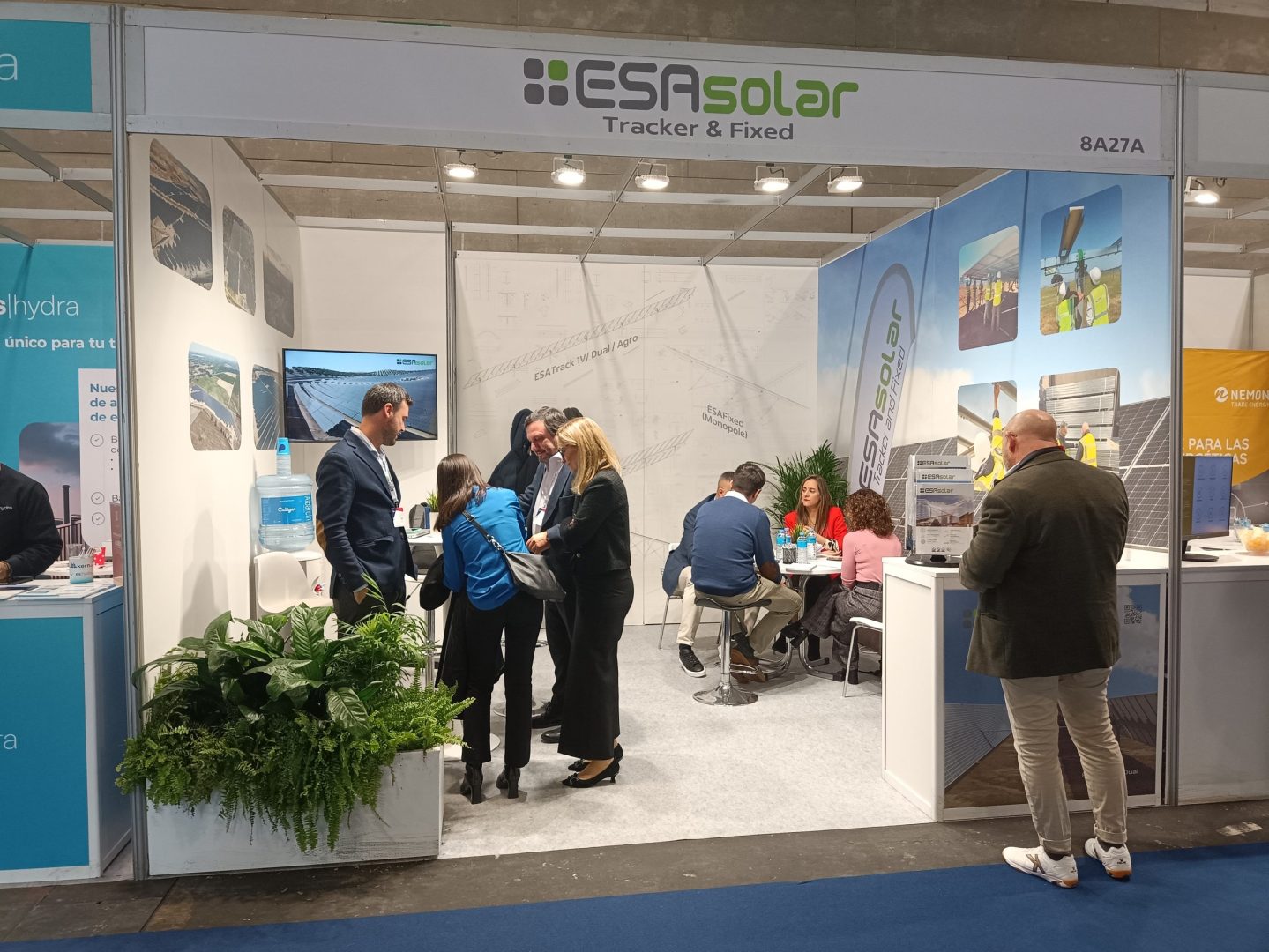
The 2025 edition of GENERA made it clear that the maturity of the photovoltaic sector is no longer measured only in installed megawatts, but also in the ability of its associated industries to respond to scenarios of high renewable penetration, greater reliability requirements, and new challenges in grid stability. In that context, the visits we received at our stand allowed us to compare concerns and solutions with developers, EPCs, and operators who are looking for something very specific: more efficient structures, faster to deploy, and better justified from a technical standpoint.
Some of the central discussions during the event focused on the need to reduce uncertainties on-site. Large plants can no longer afford wide tolerances or generic designs. High-quality topographic information, advanced structural simulation, and the mechanical stability of trackers have become direct levers to minimize downtime and ensure service continuity and traceability.
This is precisely where ESAsolar provides value. Our wind-tunnel studies for 1V and 2V trackers, carried out with Oritia & Boreas and Western University in Ontario, reinforced many of the conversations we had during the fair: increasingly, developers are seeking solid justifications for aeroelastic phenomena, induced vibrations, and extreme events. Having consolidated our own line of prototypes and testing at Los Palacios (Seville) has allowed us to offer quick—and above all, verifiable—responses.
Our civil-optimization software also generated interest. Developed in Matlab using linear-programming models and advanced geometry, it can reduce earthworks by up to 30%. This is not just a matter of cost: on complex soils and tight schedules, that efficiency directly affects the pace of assembly, piling, and final alignment of the modules.
In parallel, the sessions dedicated to foundations and geotechnics connected with our experience in Pull Out Tests and FEM analyses for design reports. Many visitors were looking for exactly that: engineering capable of justifying every design hypothesis and adjusting the solution to the real conditions of the terrain—not to a generic model.
As expected, the conversation about supply-chain resilience cut across all sessions. Our global supply capacity—up to 25 MW per week for a single project and 25 containers per week—supported by audited suppliers and advanced SCM systems, remains a critical tool for guaranteeing delivery times in increasingly competitive markets.
Our quality-control model also prompted questions. Based on in-factory personnel, continuous inspections, NDT, and exhaustive FAT before shipping, this level of supervision is a differentiator for many international stakeholders, especially in projects where any deviation immediately leads to cost overruns on site.
And, as every year, the fair was a great meeting point with teams that value technical training, installation supervision, and Commissioning & Backtracking services. Improving the learning curve of local teams continues to be key to reducing rework and ensuring tracker performance from day one.
This edition also brought notable interest in the company’s strategic evolution following our integration into Grupo Imesapi (Vinci Group). The expansion of industrial capabilities and the international reach provided by this corporate support shaped part of the conversations, along with the strengthening of our ESG practices throughout the value chain.
To those who visited our stand, thank you.
GENERA 2025 was a timely reminder that the energy transition moves at the pace enabled by its supporting engineering.
Our commitment is to keep improving the part that falls to us: reliable structures, solid data, and solutions designed for real projects—not for theoretical scenarios.